
Indian corporate are increasingly shifting away from bank funding towards alternative sources, such as equity and bond markets, as their deleveraged balance sheets have improved their ability to raise equity at better valuations. Moreover, the 100 basis points (bps) rate cut by the Reserve Bank of India (RBI) has enabled them to access long-term funds from the debt capital market at cheaper rates.

Ask rediffGURU Naveenn Kummar your insurance mutual fund and personal finance-related questions.

There has been a sharp recovery in the headline corporate earnings in the April-June 2023 quarter (Q1FY24), after a dismal showing by early bird companies. The combined net profit of the 983 listed companies that have declared their quarterly results, so far, was up 64.7 per cent year-on-year to record a high of Rs 2.68 trillion in the first quarter, but growth in earnings remained lopsided because most of the incremental gains came from a handful of companies. Moreover, the quarterly numbers showed a continued slowdown in revenue growth.

The first quarter results (Q1FY25) of Indian IT services hint towards better fiscal growth than the preceding year, but as the management commentary said, "there is still some time for the industry to be firing on all cylinders." Among the majors-Tata Consultancy Services (TCS), Infosys, HCLTech, and Wipro-it is the Bengaluru-based Infosys that has performed better, which was also evident in its full-year revenue guidance.

Vedanta, a conglomerate in mining and metals, has seen a surge in its share price on the back of multiple triggers. Its demerger appears to be on track, a strong non-ferrous commodity cycle is boosting margins, and silver bulls are interested in Hindustan Zinc, its subsidiary.

Indian information technology (IT) service providers are expected to deliver low single-digit sequential growth in the first quarter (April-June) of 2025-26 (FY26), even as macroeconomic uncertainties continue to persist due to the volatile geopolitical environment.

The mutual fund industry's QAAUM (Quarterly Average Assets Under Management) was up 37 per cent year-on-year (Y-o-Y) (9 per cent Q-o-Q) to hit Rs 59 trillion (end Q1FY25). The equity segment grew 55 per cent Y-o-Y and equity formed 56 per cent of total AUM, up 49 per cent in Q1FY24. Sequentially, AUM grew by Rs 5 trillion.

There has been a sharp slowdown in revenue and profit growth in the cement sector in recent quarters but it is yet to show in the share prices of cement companies. On the contrary, there has been a rally in cement stocks and a re-rating of their equity valuation in the past three years despite an earnings contraction during the period.

TVS Motor Company met expectations in terms of revenue and posted a strong margin performance in Q1FY25. The key drivers were material cost savings and a better mix. The domestic demand outlook looks good with a rural rebound but geopolitical uncertainties in key export markets may dent overall growth.

Asian Paints reported a good performance for the second quarter (July-September) of 2025-26 (Q2FY26), with some help from base effects, despite strong competition and extended monsoon. Volume grew in low double digits in the key domestic decorative paints, and value in that segment grew by 6 per cent. Ebitda (earnings before interest, taxes, depreciation, and amortisation) grew 21 per cent year-on-year (Y-o-Y), and PAT (profit after tax) grew 14 per cent. Asian Paints also defended market share better after several quarters where it had lost ground to Birla Opus.

The combined profit before tax of 748 companies, which have declared their results for Q1FY21, is down 46 per cent YoY. Their net sales went down by a quarter as the Covid-19 lockdown led to a sharp fall in economic activity.

The pickup was driven partly by fresh corporate investment but more by higher working-capital demand.

Top Indian cement firms are expected to report a strong earnings growth for the second quarter of the financial year 2025-26 (Q2FY26) on a year-on-year (Y-o-Y) basis, amid improved realisations, prices, and steady volume growth, but on a low base.

The 13th-month persistency rate of life insurers - an important metric indicating the retention of new policies - declined in the first quarter of 2025-26 (Q1FY26). This fall was primarily driven by a lower share of high-value policies, following taxation changes implemented in April 2023.

Trent reported decent margins in the second quarter (July-September) of 2025-26 (Q2FY26) but growth moderated. Same store growth was low single-digits. Trent's revenue growth decelerated in Q2FY26 at 17 per cent year-on-year (Y-o-Y) while area additions were offset by decline in revenue per square foot (sq ft).

The Q1FY24 earnings season has started on a dismal note for corporate India. The early-bird companies' revenue growth has been at a 10-quarter low, while the combined earnings of non-BFSI (banking, financial services, and insurance) companies seem to have hit the ceiling. The numbers suggest corporate India is entirely dependent on BFSI companies and the IT services sector to drive growth in revenue and profit while other sectors are showing signs of stagnation.

Brokerages expect Nifty50 companies to have cumulatively witnessed strong double-digit growth in their earnings in the first quarter of FY24 (Q1FY24). This growth in the combined earnings is expected to have been driven by banks, automakers, and oil & gas companies. Other sectors may report muted profit growth.
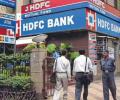
This will be the lender's first result after its merger with HDFC Ltd, effective from July 1, and will keep analysts glued to the management's earnings growth guidance for the merged financial behemoth.

From the Sensex pack, Bharti Airtel, Asian Paints, Infosys, Bharat Electronics, Tech Mahindra and Eternal were major laggards. However, Maruti, Tata Steel, Bajaj Finance, Bajaj Finserv, Trent and Tata Consultancy Services were among the gainers.

The Indian steel industry is faced with a paradox: Rising demand and falling prices. Demand continues to surge as user industries gather pace, with the World Steel Association projecting around 9 per cent annual growth for India over 2025 and 2026, the year domestic demand is projected to be almost 75 million tonnes (mt) higher than in 2020.

IndiGo share price today: IndiGo share price fell as much as 4.8 per cent to a low of Rs 4,275 per share on the BSE in Monday's intraday trade as investors booked profit in the stock post a its April-June quarter (Q1) results for financial year 2024-25 (FY25). The stock ended 1.36 per cent lower at Rs 4,430 as against a 23-points gain in the benchmark BSE Sensex. The selling also got exacerbated as the management commentary, post Q1FY25 results, highlighted that inflationary pressure could likely dent July-September (Q2FY25) performance.
Households may be feeling the pinch of higher inflation but corporate India is enjoying record high margins and profits. The combined quarterly net profit of listed companies scaled a new high in the April-June 2023 quarter owing to a sharp rise in operating and net profit. The expansion in margins more than compensated for the slowdown in revenue growth, which slipped into single digits in Q1FY24 after a gap of nine quarters.

'The kind of reach it has with so many bank branches even in the remotest part of the country, it is one channel which will play a very important role in vision of insurance for all.'

Reliance Industries Ltd (RIL) on Friday reported a 9.6 per cent year-on-year rise in net profit for the September quarter, driven by strong performance in its consumer-facing retail and telecom businesses and a recovery in its core oil-to-chemicals segment.

Given the stronger rural activity, and potential goods and services tax (GST) impact, investors are bullish on the two-wheeler (2W) segment. In August, dealers in the domestic market picked up 11 per cent more 2Ws year-on-year (Y-o-Y), despite only 2 per cent growth in retail registrations. This indicates inventory stocking ahead of the festival season. Export trends were good. TVS Motor and Royal Enfield may have gained domestic market share.

Public sector banks (PSBs) posted 16.1 per cent year-on-year (Y-o-Y) growth in net profit at Rs 39,974 crore during the June 2024 quarter. While net interest income (NII) showed subdued growth of 7.1 per cent, provisions and contingencies declined by 10.5 per cent Y-o-Y. This aided the bottom line to show steady growth.

Cement manufacturers' show during the June 2023-ended quarter (Q1FY24) has indicated an intensified slugfest for market share. For instance, Dalmia Bharat (Cement) said it has lost market share in eastern India owing to lack of price discipline. Industry analysts also said that the seasonal weakness in cement prices for Q1 is showing up earlier than usual.
IT services company HCLTech on Friday posted a 20.4 per cent rise in consolidated net profit to Rs 4,257 crore for the June-ended quarter and gave a revenue growth guidance of 3-5 per cent for FY25 on GenAI diversification and strong operational execution. For the fiscal's first quarter ended June 2024 (Q1 FY25), the revenue came in at Rs 28,057 crore, 6.6 per cent more than in the year-ago period. Seen sequentially, it was 1.6 per cent lower than the March quarter.

Equity markets will take cues from global trends and trading activity of foreign investors, while in the latter part of the week the first quarter earnings from IT majors TCS and HCL Technologies would guide investor sentiments, analysts said. Markets may consolidate after the record rally last week, experts added. "On the domestic front, the Q1 earnings season begins this week. Key companies such as TCS and HCL Technologies will release their earnings on July 11 and 12, 2024, respectively.

'Due to tariff uncertainty, automotive customers reduced their steel uplift by almost 15 per cent.'

Public-sector banks (PSBs) are attracting the attention of investors and the PSU Bank Index has gained nearly 10 per cent in the past month. PSBs have seen return on assets (RoA) climbing to 1 per cent in 2024-2025 (FY25) and margins are believed to have moved up further in the first half of this financial year (H1FY26) with asset quality remaining stable.

Voltas saw strong growth in both UCP (Unitary Cooling product) and EMPS (electro mechanical projects) segments.

You have to grow, and grow fast - that's the DNA of the JSW group, chairman Sajjan Jindal said as JSW Cement made its debut on the stock market mid-August. The remark captured not just the moment but also the momentum of JSW's growth story.

The exit of Larsen & Toubro (L&T) from the Hyderabad Metro is a long-term positive for the stock. It could be a bullish trigger, alongside higher international orders, and new opportunities in segments like defence and data centres.

GST 2.0 may cushion consumers against US tariffs, but like the 2019 corporate tax cut, it risks being another tactical fix rather than a structural growth strategy, expects Debashis Basu.

Among Sensex firms, Mahindra & Mahindra, Tech Mahindra, State Bank of India, Infosys, Adani Ports and ITC were the major gainers. However, Eternal, Sun Pharma, Tata Steel, Tata Motors, Bajaj Finance and Bharat Electronics were among the major laggards.

The Adani Group reported its highest-ever trailing twelve-month EBITDA of Rs 90,572 crore, driven by strong performance in its core infrastructure and clean energy businesses, along with contributions from its emerging airports segment, the conglomerate said on Thursday. The group reported an earnings before interest, taxes, depreciation and amortization (EBITDA) of Rs 90,572 crore for the period from July 2024 to June 2025, up from Rs 85,502 crore pre-tax profit in the trailing twelve months ending June 2024, it said in a statement.

IT major Wipro on Friday posted a 4.6 per cent year-on-year rise in its consolidated net profit for the June quarter at Rs 3,003.2 crore. The Q1 FY25 revenue of the Bengaluru-headquartered firm, however, fell 3.8 per cent to Rs 21,963.8 crore.

Utilities in the power sector present an interesting investment case at this moment. Most power stocks have lost substantial ground in the past 12 months.

Co-working spaces provider WeWork India is aiming for a revenue growth of over 20 per cent for the coming years, even as its initial public offering (IPO) with only an offer for sale (OFS) component gets valued at Rs 3,000 crore at the top of the price band. The IPO opens on October 3, a newspaper advertisement said.
